Rate this post

Easily To Pass New SOA S90.08B Dumps with 17 Questions

Latest S90.08B Study Guides 2023 – With Test Engine PDF

NO.10

Service A sends a message to Service B (1). After Service B writes the message contents to Database A (2), it issues a response message back to Service A (3). Service A then sends a message to Service C (4). Upon receiving this message, Service C sends a message to Service D (5), which then writes the message contents to Database B (6) and issues a response message back to Service C (7).
Service A and Service D are located in Service Inventory A. Service B and Service C are located in Service Inventory B.
You are told that In this service composition architecture, all four services are exchanging invoice-related data in an XML format. However, the services in Service Inventory A are standardized to use a different XML schema for invoice data than the services in Service Inventory B. Also, Database A can only accept data in the Comma Separated Value (CSV) format and therefore cannot accept XML-formatted data. Database B only accepts XML-formatted data. However, it is a legacy database that uses a proprietary XML schema to represent invoice data that is different from the XML schema used by services in Service Inventory A or Service Inventory B.
What steps can be taken to enable the planned data exchange between these four services?


NO.11 Refer to Exhibit.
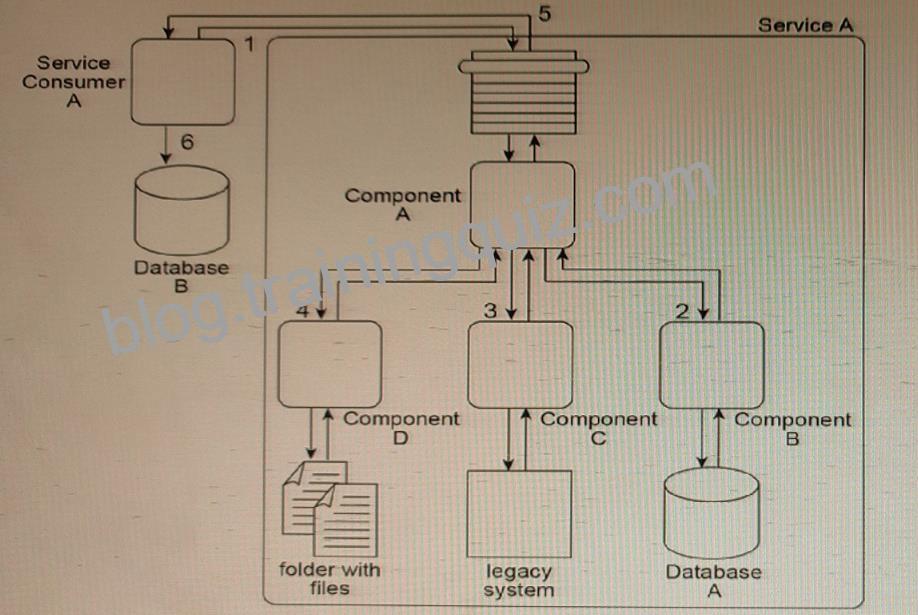
When Service A receives a message from Service Consumer A (1), the message is processed by Component A.
This component first invokes Component B (2), which uses values from the message to query Database A in order to retrieve additional data. Component B then returns the additional data to Component A. Component A then invokes Component C (3), which interacts with the API of a legacy system to retrieve a new data value. Component C then returns the data value back to Component A.
Next, Component A sends some of the data It has accumulated to Component D (4), which writes the data to a text file that is placed in a specific folder. Component D then waits until this file is imported into a different system via a regularly scheduled batch import. Upon completion of the import, Component D returns a success or failure code back to Component A. Component A finally sends a response to Service Consumer A (5) containing all of the data collected so far and Service Consumer A writes all of the data to Database B (6).
Components A, B, C, and D belong to the Service A service architecture. Database A, the legacy system and the file folders are shared resources within the IT enterprise.
Service A is an entity service with a service architecture that has grown over the past few years. As a result of a service inventory-wide redesign project, you are asked to revisit the Service A service architecture in order to separate the logic provided by Components B, C, and D into three different utility services without disrupting the behavior of Service A as it relates to Service Consumer A.
What steps can be taken to fulfill these requirements?




NO.12 Refer to Exhibit.

Service Consumer A sends a message to Service A (1), which then forwards the message to Service B (2). Service B forwards the message to Service C (3), which finally forwards the message to Service D (4). However, Services A, B and C each contain logic that reads the contents of the message to determine what intermediate processing to perform and which service to forward the message to. As a result, what is shown in the diagram is only one of several possible runtime scenarios.
Currently, this service composition architecture is performing adequately, despite the number of services that can be involved in the transmission of one message. However, you are told that new logic is being added to Service A that will require it to compose one other service to retrieve new data at runtime that Service A will need access to in order to determine where to forward the message to. The involvement of the additional service will make the service composition too large and slow.
What steps can be taken to improve the service composition architecture while still accommodating the new requirements and avoiding an increase in the amount of service composition members?


NO.13 Refer to Exhibit.

Service A is a task service that sends Service B a message (2) requesting that Service B return data back to Service A in a response message (3). Depending on the response received, Service A may be required to send a message to Service C (4) for which it requires no response.
Before it contacts Service B, Service A must first retrieve a list of code values from its own database (1) and then place this data into its own memory. If it turns out that it must send a message to Service C, then Service A must combine the data it receives from Service B with the data from the code value list in order to create the message it sends to Service C. If Service A is not required to invoke Service C, it can complete its task by discarding the code values.
Service A and Service C reside in Service Inventory A. Service B resides in Service Inventory B.
You are told that the services in Service Inventory A were designed with service contracts that are based on different design standards and technologies than the services In Service Inventory B. As a result, Service A is a SOAP-based Web service and Service B Is a REST service that exchanges JSON-formatted messages. Therefore, Service A and Service B cannot currently communicate. Furthermore, Service C is an agnostic service that is heavily accessed by many concurrent service consumers. Service C frequently reaches its usage thresholds, during which it is not available and messages sent to it are not received.
What steps can be taken to solve these problems?


NO.14

Service A is an entity service that provides a set of generic and reusable service capabilities. In order to carry out the functionality of any one of its service capabilities, Service A is required to compose Service B (1) and Service C (2), and Service A is required to access Database A (3), Database B (4), and Database C (5). These three databases are shared by other applications within the IT enterprise.
All of service capabilities provided by Service A are synchronous, which means that for each request a service consumer makes, Service A is required to issue a response message after all of the processing has completed.
Service A is one of many entity services that reside In a highly normalized service Inventory. Because Service A provides agnostic logic, it is heavily reused and is currently part of many service compositions.
You are told that Service A has recently become unstable and unreliable. The problem has been traced to two issues with the current service architecture. First, Service B, which Is also an entity service, is being increasingly reused and has itself become unstable and unreliable. When Service B fails, the failure is carried over to Service A. Secondly, shared Database B has a complex data model. Some of the queries issued by Service A to shared Database B can take a very long time to complete.
What steps can be taken to solve these problems without compromising the normalization of the service inventory?


NO.15

The Client and Vendor services are agnostic services that are both currently part of multiple service compositions. As a result, these services are sometimes subjected to concurrent access by multiple service consumers.
The Client service primarily provides data access logic to a client database but also coordinates with other services to determine a clients credit rating. The Vendor service provides some data access logic but can also generate various dynamic reports based on specialized business requirements.
After reviewing historical statistics about the runtime activity of the two services, it is discovered that the Client service is serving an ever-increasing number of service consumers. It is regularly timing out, which in turn increases its call rate as service consumers retry their requests. The Vendor serviceoccasionally has difficulty meeting its service-level agreement (SLA) and when this occurs, penalties are assessed.
Recently, the custodian of the Client service was notified that the Client service will be made available to new service consumers external to its service inventory. The Client service will be providing free credit rating scores to any service consumer that connects to the service via the Internet. The Vendor service will remain internal to the service inventory and will not be exposed to external access.
Which of the following statements describes a solution that addresses these issues and requirements?


NO.16

Services A, B, and C are non-agnostic task services. Service A and Service B use the same shared state database to defer their state data at runtime.
An assessment of the three services reveals that each contains some agnostic logic that cannot be made available for reuse because it is bundled together with non-agnostic logic.
The assessment also determines that because Service A, Service B and the shared state database are each located in physically separate environments, the remote communication required for Service A and Service B to interact with the shared state database is causing an unreasonable decrease in runtime performance.
How can the application of the Orchestration pattern improve this architecture?


NO.17 Refer to Exhibit.

Service Consumer A and Service A reside in Service Inventory A. Service B and Service C reside in Service Inventory B. Service D is a public service that can be openly accessed via the World Wide Web. The service is also available for purchase so that it can be deployed independently within IT enterprises. Due to the rigorous application of the Service Abstraction principle within Service Inventory B, the only information that is made available about Service B and Service C are the published service contracts. For Service D, the service contract plus a service level agreement (SLA) are made available. The SLA indicates that Service D has a planned outage every night from 11:00pm to midnight.
You are an architect with a project team that is building services for Service Inventory A. You are told that the owners of Service Inventory A and Service Inventory B are not generally cooperative or communicative. Cross-inventory service composition is tolerated, but not directly supported. As a result, no SLAs for Service B and Service C are available and you have no knowledge about how available these services are. Based on the service contracts you can determine that the services in Service Inventory B use different data models and a different transport protocol than the services in Service Inventory A. Furthermore, recent testing results have shown that the performance of Service D is highly unpredictable due to the heavy amount of concurrent access it receives from service consumers from other organizations. You are also told that there is a concern over how long Service Consumer A will need to remain stateful while waiting for a response from Service A.
What steps can be taken to solve these problems?


NO.18

When Service A receives a message from Service Consumer A (1), the message is processed by Component A. This component first invokes Component B (2), which uses values from the message to query Database A in order to retrieve additional data. Component B then returns the additional data to Component A. Component A then invokes Component C (3), which interacts with the API of a legacy system to retrieve a new data value.
Component C then returns the data value back to Component A.
Next, Component A sends some of the data It has accumulated to Component D (4), which writes the data to a text file that is placed in a specific folder. Component D then waits until this file is imported into a different system via a regularly scheduled batch import. Upon completion of the import, Component D returns a success or failure code back to Component A. Component A finally sends a response to Service Consumer A (5) containing all of the data collected so far and Service Consumer A writes all of the data to Database B (6).
Components A, B, C, and D belong to the Service A service architecture. Database A, the legacy system and the file folders are shared resources within the IT enterprise.
Service A is an entity service with a service architecture that has grown over the past few years. As a result of a service inventory-wide redesign project, you are asked to revisit the Service A service architecture in order to separate the logic provided by Components B, C, and D into three different utility services without disrupting the behavior of Service A as it relates to Service Consumer A.
What steps can be taken to fulfill these requirements?


NO.19 Refer to Exhibit.

Service Consumer A sends Service A a message containing a business document (1). The business document is received by Component A, which keeps the business document in memory and forwards a copy to Component B (3). Component B first writes portions of the business document to Database A (4). Component B then writes the entire business document to Database B and uses some of the data values from the business document as query parameters to retrieve new data from Database B (5).
Next, Component B returns the new date* back to Component A (6), which merges it together with the original business document it has been keeping in memory and then writes the combined data to Database C (7). The Service A service capability invoked by Service Consumer A requires a synchronous request-response data exchange. Therefore, based on the outcome of the last database update, Service A returns a message with a success or failure code back to Service Consumer A (8).
Databases A and B are shared, and Database C is dedicated to the Service A service architecture.
There are several problems with this architecture. The business document that Component A is required to keep in memory (while it waits for Component B to complete its processing) can be very large. The amount of runtime resources Service A uses to keep this data in memory can decrease the overall performance of all service instances, especially when it is concurrently invoked by multiple service consumers. Additionally, Service A can take a long time to respond back to Service Consumer A because Database A is a shared database that sometimes takes a long time to respond to Component B. Currently, Service Consumer A will wait for up to 30 seconds for a response, after which it will assume the request to Service A has failed and any subsequent response messages from Service A will be rejected.
What steps can be taken to solve these problems?


NO.20

Service A is a task service that is required to carry out a series of updates to a set of databases in order to complete a task. To perform the database updates. Service A must interact with three other services that each provides standardized data access capabilities.
Service A sends its first update request message to Service B (1), which then responds with a message containing either a success or failure code (2). Service A then sends its second update request message to Service C (3), which also responds with a message containing either a success or failure code (4). Finally, Service A sends a request message to Service D (5), which responds with its own message containing either a success or failure code (6).
Services B, C and D are agnostic services that are reused and shared by multiple service consumers. This has caused unacceptable performance degradation for the service consumers of Service A as it is taking too long to complete its overall task. You’ve been asked to enhance the service composition architecture so that Service A provides consistent and predictable runtime performance. You are furthermore notified that a new type of data will be introduced to all three databases. It is important that this data is exchanged in a standardized manner so that the data model used for the data in inter-service messages is the same.
What steps can be taken to fulfill these requirements?


NO.21

Service Consumer A and Service A reside in Service Inventory A. Service B and Service C reside in Service Inventory B. Service D is a public service that can be openly accessed via the World Wide Web. The service is also available for purchase so that it can be deployed independently within IT enterprises. Due to the rigorous application of the Service Abstraction principle within Service Inventory B, the only information that is made available about Service B and Service C are the published service contracts. For Service D, the service contract plus a service level agreement (SLA) are made available. The SLA indicates that Service D has a planned outage every night from 11:00pm to midnight.
You are an architect with a project team that is building services for Service Inventory A. You are told that the owners of Service Inventory A and Service Inventory B are not generally cooperative or communicative.
Cross-inventory service composition is tolerated, but not directly supported. As a result, no SLAs for Service B and Service C are available and you have no knowledge about how available these services are. Based on the service contracts you can determine that the services in Service Inventory B use different data models and a different transport protocol than the services in Service Inventory A. Furthermore, recent testing results have shown that the performance of Service D is highly unpredictable due to the heavy amount of concurrent access it receives from service consumers from other organizations. You are also told that there is a concern over how long Service Consumer A will need to remain stateful while waiting for a response from Service A.
What steps can be taken to solve these problems?


NO.22

Our service inventory contains the following three services that provide Invoice-related data access capabilities: Invoice, InvProc and Proclnv. These services were created at different times by different project teams and were not required to comply with any design standards. Therefore, each of these services has a different data model for representing invoice data.
Currently, each of these three services has a different service consumer: Service Consumer A accesses the Invoice service (1), Service Consumer B (2) accesses the InvProc service, and Service Consumer C (3) accesses the Proclnv service. Each service consumer invokes a data access capability of an invoice-related service, requiring that service to interact with the shared accounting database that is used by all invoice-related services (4, 5, 6).
Additionally, Service Consumer D was designed to access invoice data from the shared accounting database directly (7). (Within the context of this architecture, Service Consumer D is labeled as a service consumer because it is accessing a resource that is related to the illustrated service architectures.) Assuming that the Invoice service, InvProc service and Proclnv service are part of the same service inventory, what steps would be required to fully apply the Official Endpoint pattern?


NO.23

The architecture for Service A displayed in the figure shows how the core logic of Service A has expanded over time to connect to a database and a proprietary legacy system (1), and to support two separate service contracts (2) that are accessed by different service consumers.
The service contracts are fully decoupled from the service logic. The service logic is therefore coupled to the service contracts and to the underlying implementation resources (the database and the legacy system).
Service A currently has three service consumers. Service Consumer A and Service Consumer B access Service A’s two service contracts (3, 4). Service Consumer C bypasses the service contracts and accesses the service logic directly (5).
You are told that the database and legacy system that are currently being used by Service A are being replaced with different products. The two service contracts are completely decoupled from the core service logic, but there is still a concern that the introduction of the new products will cause the core service logic to behave differently than before.
What steps can be taken to change the Service A architecture in preparation for the introduction of the new products so that the impact on Service Consumers A and B is minimized? What further step can be taken to avoid consumer-to-implementation coupling with Service Consumer C?


S90.08B Dumps and Exam Test Engine: https://www.trainingquiz.com/S90.08B-practice-quiz.html

Related Links: myportal.utt.edu.tt myportal.utt.edu.tt myportal.utt.edu.tt myportal.utt.edu.tt myportal.utt.edu.tt myportal.utt.edu.tt

Leave a Reply

Please sing in to post your comment or singup if you don't have account.
Enter the text from the image below